Characterizing the innermost gaseous layers of an AGB star

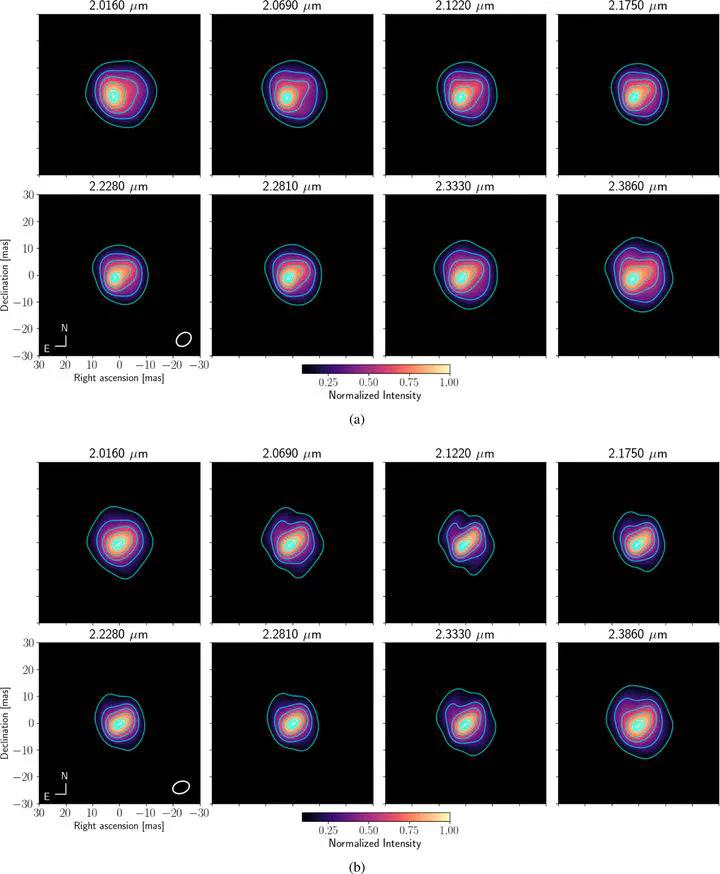 Image credit: A&A
Abstract
**Context.** The mass-loss mechanisms in M-type asymptotic giant branch (AGB) stars are still not well understood; these include, in particular, the formation of dust-driven winds from the innermost gaseous layers around these stars. One way to understand the gas-dust interaction in these regions and its impact on the mass-loss mechanisms is through the analysis of high-resolution observations of the stellar surface and its closest environment.
**Aims.** We aim to characterize the inner circumstellar environment (~3 R*) of the M-type Mira star R Car in the near-infrared at different phases of a pulsation period.
**Methods.** We used GRAVITY interferometric observations in the K band obtained during two different epochs over 2018. Those data were analyzed using parametric models and image reconstruction of both the pseudo-continuum and the CO band heads observed. The reported data are the highest angular resolution observations on the source in the K band.
**Results.** We determined sizes of R Car’s stellar disk of 16.67 ± 0.05 mas (3.03 au) in January 2018 and 14.84 ± 0.06 mas (2.70 au) in February, 2018, respectively. From our physical model, we determined temperatures and size ranges for the innermost CO layer detected around R Car. The derived column density of the CO is in the ~9.18×10¹⁸–1×1019 cm−2 range, which is sufficient to permit dust nucleation and the formation of stable dust-driven winds. We find that magnesium composites, Mg2SiO4 and MgSiO3, have temperatures and condensation distances consistent with the ones obtained for the CO layer model and pure-line reconstructed images, which are the dust types most likely to be responsible for wind formation. Our reconstructed images show evidence of asymmetrical and inhomogeneous structures, which might trace a complex and perhaps clumpy structure of the CO molecule distribution.
**Conclusions.** Our work demonstrates that the conditions for dust nucleation and thus for initialising dust-driven winds in M-type AGB stars are met in R Car, and we identify magnesium composites as the most probable candidates. We find structural changes between two observing epochs (which are separated by ~10% of the full pulsation period of the star) and evidence of the effects of asymmetries and clumpiness. This observational evidence is crucial to constraining the role of convection and pulsation in M-type stars.
Type
Publication
Astronomy & Astrophysics
With the advent of high angular resolution techniques, scientists are finding that the innermost environment of AGB stars is asymmetric and changes over short time periods of the order of days.
Add the publication’s full text or supplementary notes here. You can use rich formatting such as including code, math, and images.