Convection Cells in AGB stars

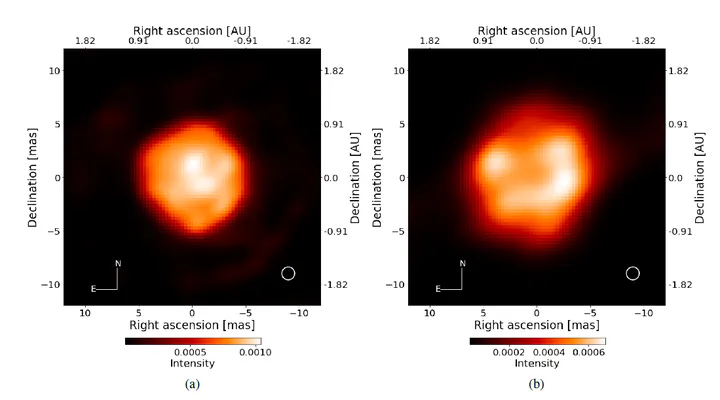 Image credit: A&A
Abstract
**Context.** Stellar convection plays an important role in atmospheric dynamics, wind formation, and the mass-loss processes in asymptotic giant branch stars. However, a direct characterization of convective surface structures in terms of size, contrast, and lifespan is quite challenging, as spatially resolving these features requires the highest angular resolution.
**Aims.** We aim to characterize the size of convective structures on the surface of the O-rich AGB star R Car to test different theoretical predictions based on mixing-length theory from solar models.
**Methods.** We used infrared low-spectral resolution (R ~ 35) interferometric data in the H-band (~1.76 microns) obtained by the instrument PIONIER at the Very Large Telescope Interferometer (VLTI) to image the star’s surface at two epochs separated by approximately six years. Using a power spectrum analysis, we estimated the horizontal size of the structures on the surface of R Car. The sizes of the stellar disk at dfferent phases of a pulsation cycle were obtained using parametric model fitting in the Fourier domain.
**Results.** Our analysis supports that the sizes of the structures in R Car are correlated with variations in the pressure scale height in the atmosphere of the target, as predicted by theoretical models based on solar convective processes. We observed that these structures grow in size when the star expands within a pulsation cycle. While the information is still scarce, this observational finding highlights the role of convection in the dynamics of those objects. New interferometric imaging campaigns with the renewed capabilities of the VLTI are envisioned to expand our analysis to a larger sample of objects.
Type
Publication
In Astronomy & Astrophysics
If you search for images of the Sun on the internet, you will likely find many showing a granular pattern caused by convective currents. But did you know that evolved stars exhibit gigantic granular patterns? In this article, we show you what these structures look like for an AGB star called R Car
Add the publication’s full text or supplementary notes here. You can use rich formatting such as including code, math, and images.